

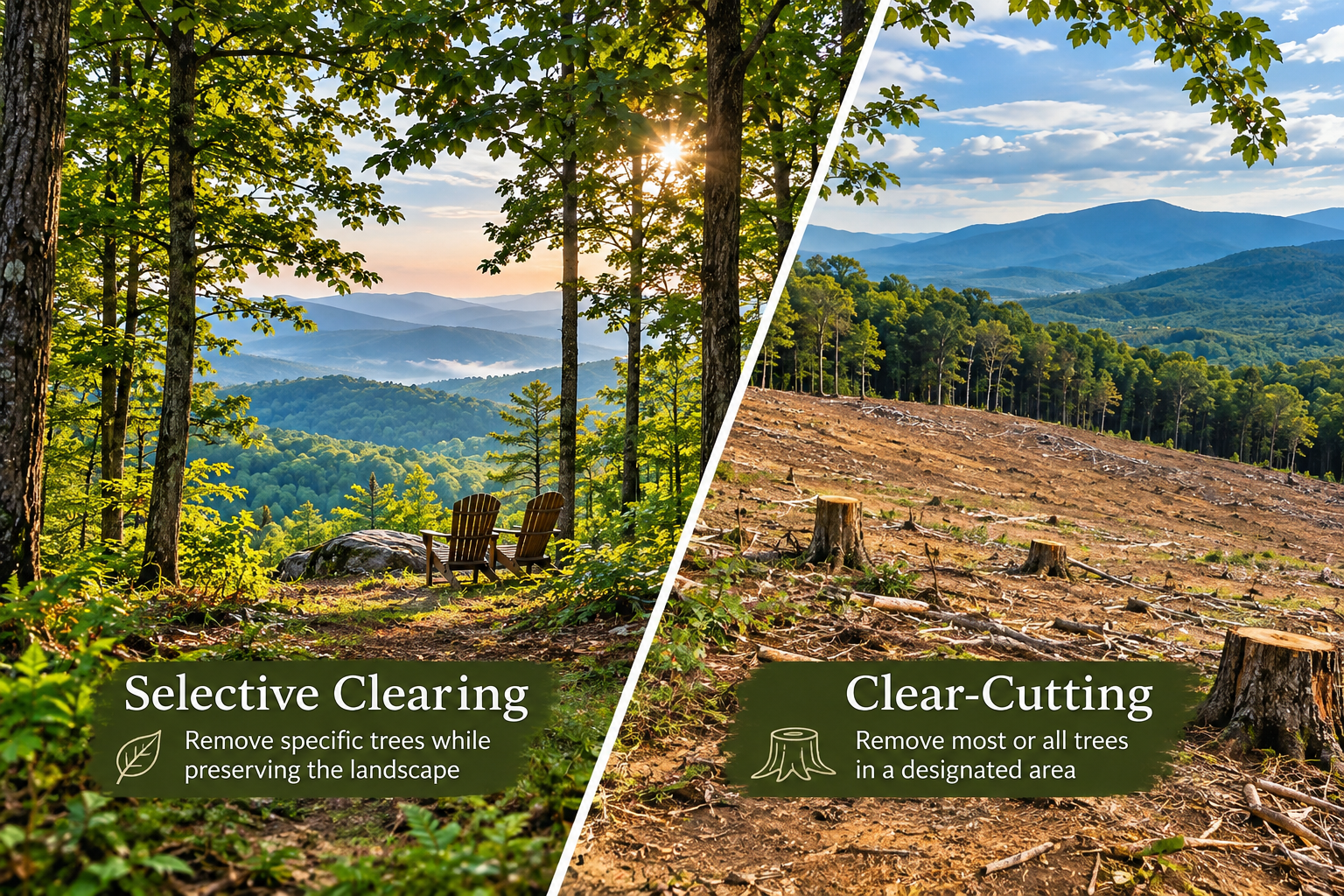
Whether you’re opening up a mountain view, creating space to build a home, improving access to acreage, or preparing land for a future project, clearing trees can significantly change a property’s landscape. But not all land clearing is the same.
Two common approaches are selective clearing and clear-cutting. While both involve removing trees and vegetation, they differ considerably in how much of the existing landscape is disturbed and what remains afterward. In the Southern Appalachian region, where steep terrain, mature forests, waterways, and diverse wildlife habitats are common, choosing the right approach deserves careful consideration.
Understanding the difference between selective clearing and clear-cutting can help you make informed decisions about land management, environmental impact, and the long-term health of your property. At Best Earth Solutions, our ISA-certified arborist can provide the information you need to make the most of your property.

What Is Selective Clearing?
Selective clearing is the process of removing specific trees, shrubs, and other vegetation while intentionally preserving selected portions of the existing landscape. Rather than removing everything within a designated area, this approach focuses on identifying which vegetation needs to go and which should remain.
Depending on your goals, selective clearing may involve:
- Removing dead, diseased, or hazardous trees.
- Removing trees that obstruct desired views.
- Clearing vegetation to create access paths, driveways, or building areas.
- Thinning overcrowded areas to improve growing conditions for selected trees.
- Removing invasive plants that compete with native vegetation.
Selective clearing can be useful if you want to make improvements without completely changing the character of your land. For example, a wooded mountain property may have a beautiful long-range view hidden behind a dense grouping of trees. Instead of clearing the entire hillside, a carefully planned project may remove selected trees and vegetation to open the desired sightline. The result is a more intentional landscape that balances the property’s practical needs with the value of its existing natural features.
What Is Clear-Cutting?
Clear-cutting is a land management practice in which most or all trees within a designated area are removed during a single operation. It is commonly associated with timber harvesting, large-scale land conversion, and certain forestry management practices. Depending on the project, vegetation and smaller trees may also be removed, leaving the area substantially more exposed.
Clear-cutting can serve legitimate purposes. For example, it may be used in forestry operations where certain tree species require significant sunlight to regenerate, or where an area is being intentionally converted for another use. However, removing most or all tree cover can dramatically change the conditions across a property.
Without the protection of an established canopy and root systems, exposed soil may become more vulnerable to erosion, particularly on steep slopes. Rainfall reaches the ground more directly, and increased surface runoff may carry sediment into nearby drainage areas and waterways. The loss of mature trees also reduces existing wildlife habitat, shade, and the ecological relationships that develop within an established forest ecosystem.
These effects don’t mean clear-cutting is always a bad idea. They do mean that the decision should account for site conditions, intended land use, and erosion control.
Selective Clearing vs. Clear-Cutting: Key Differences
The biggest difference between these two approaches is the amount of trees removed and how much of the existing ecosystem remains intact.
Selective clearing:
- Requires careful planning to determine which vegetation should remain.
- Removes specific trees and vegetation based on defined objectives.
- Retains selected mature trees and portions of the existing canopy.
- Can help preserve habitat, shade, and soil stability.
Clear-cutting:
- Removes most or all trees within a designated area.
- Creates a substantially more open landscape.
- Can expose soil to increased erosion and runoff.
- Removes much of the existing canopy and tree-dependent habitat.
Neither approach should be chosen simply because it is faster or more convenient. The right method depends on the property’s intended use, existing conditions, and long-term management goals. Working with a skilled arborist is a great way to assess your property and the best options to achieve your goals.
Why Selective Clearing Can Be Valuable on Mountain Properties
The terrain throughout North Georgia and the Southern Appalachians creates unique considerations for land clearing. Slopes, rocky soils, heavy rainfall, wooded drainage areas, and natural waterways all influence how a property responds when vegetation is removed. On sloped properties, tree roots help anchor soil, while leaf litter and ground vegetation help protect the surface from rainfall. Removing too much vegetation can expose vulnerable areas and increase the potential for erosion.
Selective clearing may help you accomplish specific goals while retaining the natural features that support your landscape. For example, you may want to:
- Open a view of the surrounding mountains.
- Create a clearing for a garden or outdoor living area.
- Create a driveway or improve access to an existing structure.
- Remove hazardous trees near a home or outbuilding.
- Improve the growing conditions of desirable trees.
- Prepare a limited area for future construction.
In some situations, retaining mature trees along property boundaries, drainage areas, and steep slopes can help maintain shade, habitat, and soil stability. However, selective clearing still requires careful execution. Removing individual trees can affect neighboring trees, expose previously shaded vegetation, and disturb soil. Even a relatively small clearing project can have unintended consequences if the surrounding landscape isn’t considered.
Environmental Considerations Before Clearing Land
Before beginning any clearing project, it helps to understand what is already present on the property. A wooded area may contain mature hardwoods, native understory plants, wildlife habitat, seasonal drainage channels, and other features that contribute to the health of the ecosystem. A few important considerations include:
- Soil and erosion: Identify steep slopes, exposed soil, drainage channels, and areas where removing vegetation could increase runoff. Maintaining appropriate ground cover and erosion controls can help reduce disturbance.
- Waterways and drainage: Trees and vegetation near streams, wetlands, and drainage areas can provide important ecological functions. Applicable streamside buffer requirements and local regulations should be reviewed.
- Wildlife habitat: Mature trees, nesting areas, standing dead trees, and fallen logs may provide valuable habitat. Where practical and safe, retaining selected natural features can help support local wildlife.
- Native and invasive vegetation: Not all vegetation has the same ecological value. Identifying desirable native species and invasive plants can help guide decisions about what to preserve and what to remove.
- Future land use: Consider how the property will be used after clearing. A driveway, home site, garden, pasture, and mountain view each have different requirements. Planning around the intended outcome can help prevent unnecessary removal and repeated disturbance.
For larger projects, property owners may also need to consult forestry professionals, engineers, environmental specialists, or local permitting authorities.
How to Approach a Land Clearing Project Responsibly
A successful clearing project begins before equipment arrives on the property. Start by identifying the specific goals. Is the objective:
- to create access?
- remove hazardous trees?
- open a view?
- prepare an area for development?
Having a clear purpose helps determine how much vegetation actually needs to be removed.
Next, evaluate the site. Consider tree health, species, slope, soil conditions, drainage, surrounding structures, and existing vegetation. It may be possible to accomplish the desired result with a smaller footprint. Once the project area is understood, identify which trees and vegetation should remain. Marking preservation areas and establishing clear work boundaries can help prevent unnecessary disturbance.
Finally, consider what happens after the clearing is complete. Depending on the site, restoration may involve stabilizing exposed soil, establishing appropriate ground cover, managing invasive plants, or incorporating native vegetation.
Making Thoughtful Decisions About Your Land
Clearing land is sometimes necessary to make a property safer, more accessible, or better suited to its intended use. But removing vegetation doesn’t have to mean removing everything.
At Best Earth Solutions, we believe good land management starts with understanding the land itself. Our approach to professional tree care considers the condition of individual trees, the surrounding environment, and your goals. Whether you’re opening a mountain view, addressing hazardous trees, or planning improvements to wooded acreage, thoughtful decisions can help create a landscape that works for you while respecting the natural systems already in place.
Professional Tree Care and Land Management in North Georgia
Best Earth Solutions provides professional tree care services in Blue Ridge, Ellijay, Blairsville, Murphy, and surrounding communities. From selective tree removal and pruning to view cutting and complex tree work, we help property owners make informed decisions about the trees on their land.
Contact us to discuss your property’s tree care needs and explore a thoughtful approach to managing your landscape.
Leave a Reply